
Chapter 9: Government & Educational Institutions
IN THIS LESSON
Strategic Partnerships with Governments & Educational Institutions—Expanding Your Ecosystem
Your organization exists within a broader ecosystem of community resources. While donations from individuals, corporations, and foundations are vital, building strategic partnerships with government and educational institutions is another powerful way to secure resources and scale your impact. These relationships, which can be both monetary and non-monetary, are often a hallmark of a maturing organization and can provide long-term stability that goes beyond a single financial transaction.
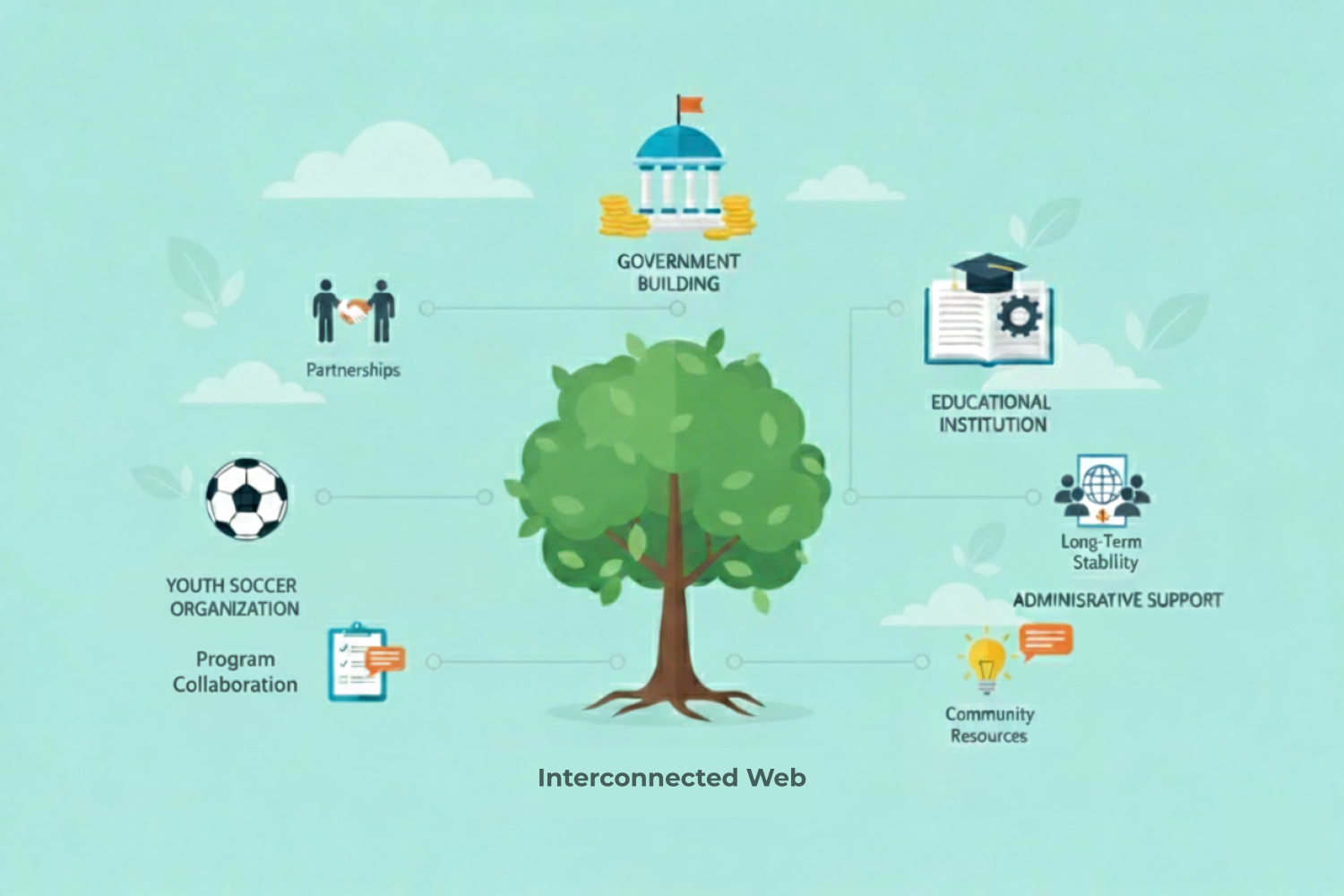
The Value of Strategic Partnerships
Partnerships with government and educational institutions are unique because they are often a strategic alliance where you and your partner leverage each other's strengths to achieve a shared goal. As a soccer club or community-based organization, your value is in your ability to engage the community, provide programming, and offer opportunities for youth development. For a government or educational institution, their value is in their resources, facilities, and expertise.
These relationships become particularly important as an organization grows from the "Branching Out" (Stage 4) to the "Canopy Growth" (Stage 6) and "Evergreen" (Stage 7) stages, where scaling impact is the primary goal.
Partnerships with Government
These partnerships are often the most foundational. They can include:
Facility Access: Gaining access to public parks, school fields, and other facilities, which is a significant operational cost savings for your organization.
Grant Funding: Many federal, state, and local governments offer grants for youth sports and community programs.
Civic Recognition: Aligning with a government entity can boost your organization's credibility and public profile.
For example, one successful soccer association partnered with its local county to secure turf fields at a middle school, an initiative that provides safe playing spaces for thousands of community children. This type of collaboration shows how a well-managed organization can successfully engage with civic leaders to achieve a shared vision.
Partnerships with Educational Institutions
These partnerships can provide unique opportunities for both your players and your organization's mission. They can include:
Facility Sharing: Partnering with a local college or university to use their facilities for training or games. This can also work in reverse: if a club or community-based organization owns their own facilities, they can form long-term rental agreements with educational institutions, making the business model of their facility sustainable.
Expertise and Volunteers: Tapping into a university's athletic department for coach education or using students as volunteers for community programs.
Player Pathways: Creating a direct pathway for your players to be seen by college recruiters and coaches.
The Partnership Process
Building these partnerships requires a strategic and proactive approach. According to COGEO's methodology, the process involves these key steps:
Research
Identify potential partners and their priorities. What are the key goals of your local Parks and Recreation Department? What is the mission of the Athletic Department at the nearest university? Find areas where your mission and theirs overlap.
Connecting
Use your network to find a key contact at the institution. This could be a staff member, a board member who works for the city, or an alumnus who works at the university. This personal connection is often the most effective way to start the conversation.
Develop a Shared Vision
Unlike a direct financial ask, the initial conversation should focus on a shared vision. Create a win-win proposal that shows how the partnership benefits both parties. For example, your club provides a safe environment and programming, while the school provides the facilities. This collaboration advances both of your missions.
Conclusion
Strategic partnerships are about more than just funding. They are about building a resilient and interconnected ecosystem that allows your organization to scale its impact and achieve a lasting legacy. By proactively identifying and building alliances with government and educational institutions, you can unlock resources and opportunities that would otherwise be out of reach.